
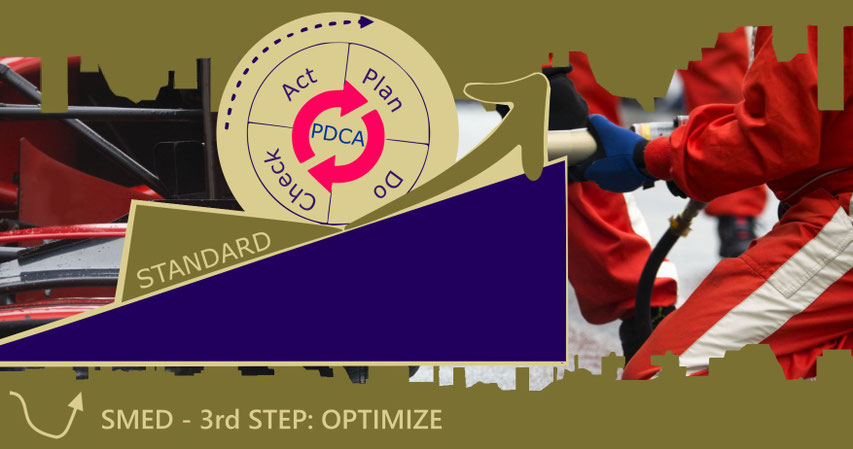
This third part deals with optimizing the changeover process. Essentially, this optimization is nothing more than continuous improvement of the changeover standard. SMED does not end with the definition of a standard—rather, this is where the actual improvement begins.
Why standards are indispensable
For many people, working with standards often seems strange or even restrictive at first. Yet standards are an integral part of our everyday lives.
Whether it's the rules of soccer, the recipe for grandma's best apple cake, or traffic regulations, standards are everywhere. They ensure that we can rely on consistently good quality, defined effort, and predictable time requirements.
In other words, standards ensure that knowledge and experience gained are retained – and that is precisely how they can be systematically improved in the first place.
So, what exactly is a standard?
A standard describes the currently best practice for a repetitive process. The word “currently” is key here: a standard is not a rigid rule, but rather a snapshot of the current state of knowledge.
A changeover process is a repetitive activity – and therefore ideal for standardization.
Who sets the standard?
The changeover standard is determined by the people involved in the process, usually by an interdisciplinary team. This team has technical authority over the standard and continuously develops it further in regular meetings.
This is based on the detailed setup steps described in the second part. These are now examined individually and systematically.

Systematic optimization of the changeover steps
Each individual step is examined from different perspectives:
1. Can this step be carried out in a time-neutral manner?
- The aim is to avoid downtime, e.g. by:
- Transferring the step to external activities
- Carrying out several steps in parallel
2. Can this step be eliminated?
- Why is this step carried out at all?
- Can it be omitted entirely?
- Can steps be combined?
- What would need to change to make the step redundant?
- A key principle here is: avoid adjustments wherever possible.
3. Can this step be accelerated?
- How can it be carried out more quickly?
- Is it possible to work without tools?
- Can simple technical solutions help?
- Is the workplace optimally designed according to 5S?
- Can distances be reduced through analysis, e.g., with a spaghetti diagram?
Alternatively or in addition, an ECRS analysis (eliminate, combine, rearrange, simplify) can also be used for this analysis. This is a very similar method for process
optimization in which processes are systematically eliminated, combined, changed, or simplified to increase efficiency and quality.
No continuous improvement without standards
Durch das strukturierte Zusammenwirken des Teams entsteht eine kontinuierliche Optimierung des Rüststandards. Der Standard ist dabei die Manifestation des aktuellen Zustands und zugleich die Grundlage für den PDCA-Zyklus.
Im Kontext der Rüstzeitoptimierung bietet er die Möglichkeit, geplante Verbesserungen im realen Umfeld zu testen, ihre Wirksamkeit zu überprüfen und gezielt weiterzuentwickeln.
Flankiert wird diese kontinuierliche Verbesserung durch bewährte Methoden wie 5S sowie durch Fehlervermeidung mittels Poka Yoke, um Geschwindigkeit, Qualität und Sicherheit gleichermaßen zu erhöhen.
Are you interested in not only understanding the SMED principles presented here, but also implementing them in your business?
On our SMED theme page, you can learn how our company supports businesses in systematically analyzing changeover processes, establishing standards, and permanently reducing changeover times.
Please feel free to contact us. We would be happy to conduct an initial, non-binding analysis of your setup process and identify areas with specific potential for improvement.