
Setup processes are an indispensable part of production, but in many companies they are still carried out quite intuitively / unmanaged. This is particularly evident in companies with no experience of SMED (Single Minute Exchange of Die), where a clear pattern emerges: each setup technician has their own approach, there are hardly any fixed procedures, the number of people involved varies, and there is often no structured preparation for the setup process. The result is a setup process that is characterized by constant interruptions—with considerable machine downtime and an unnecessary waste of time and resources.
The first step toward faster setup therefore does not begin with stopwatch measurements or technical modifications, but with a fundamental examination of the setup process itself. If you want to understand why a setup process takes a long time, you first need to recognize everything that is necessary to carry it out without interruption. In practice, it has been shown that when tool changes are not prepared in advance, materials, tools, aggregates, or information are constantly being searched for during downtime. These search and waiting times are among the “low-hanging fruits” of setup time optimization—they can be drastically reduced without much effort.
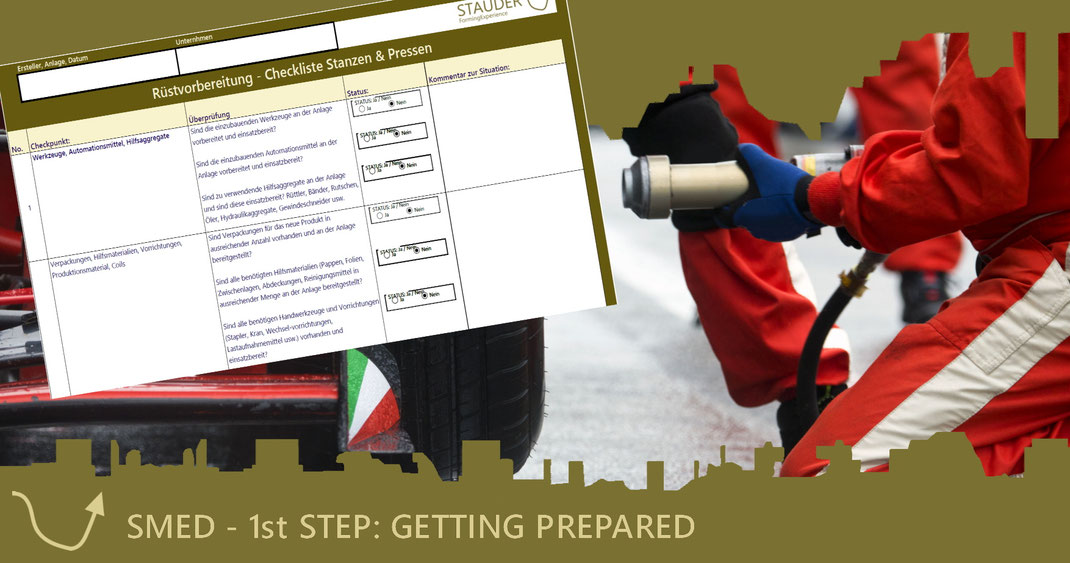
Preparing the setup process in advance can cut setup time in half for many companies. It is crucial to have all the necessary resources ready before starting setup. The following areas should be systematically checked:
1. Tools, automation equipment, and auxiliary units
- Are the tools, automation equipment, and auxiliary units to be installed—such as joggers, conveyor belts, chutes, oilers, hydraulic units, or tapping units-fully prepared and ready for use?
2. Packaging, auxiliary materials, and production materials
- Are there sufficient quantities of packaging and auxiliary materials such as cardboard, film/foil, seperating sheets, or cleaning agents available?
- Are all necessary devices such as forklifts, cranes, changing devices, or handling equipment available?
- Is all production material (e.g., coils) present at the decoiler?
3. Qulity control
- Can production start without delay after the setup process?
- Is die status /maintenance information from the tool shop available?
- Are gauges provided for a quick check and are the test conditions defined?
- Is the person responsible for quality approval informed and available?
4. Employees and organization
- Is the number of employees available in accordance with standard?
- Have they been trained in the changeover process, and have any deviations or special features been discussed in advance?
- Have maintenance, dieshop, shift leaders, and press shop management been informed?
5. Instructions, settings, and standards
- Are all necessary instructions available?
- Are settings up-to-date and available?
- Are setup standards available, visualized, and known?
6. History and energy supply
- Have problems from previous setup processes been taken into account?
- Is all the energy required for production available and has it been checked?
An uninterrupted setup process does not happen by chance—it is the result of consistent preparation. Checklists are the key to this: either analog, where items are checked off, or digital,
integrated into the MES or shop floor system.
The rule is: no setup process without setup preparation. This is the only way to make the transition from a chaotic setup process to one that is predictable, stable, and significantly
faster.
Would you like to implement SMED directly in your company and significantly reduce setup times? In our hands-on in-house workshop “Quick Changeover According to SMED”, we show you step by step how to analyze, prepare, and standardize setup processes.